
|
 |
 |
 |
 |
 |
 |
 |
 |
 |
 |
|
The first US Navy ship to be sunk by the Japanese during World War II took place on this day in 1937. After Japan had occupied Manchuria in 1931 and set up a puppet state, war would be the inevitable outcome and on July 8, 1937 it became a reality. By December the fighting had spread to Nanjing (Nanking) the capital where the U.S. Embassy was located. While most of the embassy personnel had already been evacuated several were there until the last minute, it was the job of a river gunboat named Panay to remove them to safety. The USS Panay PR-5 was built in 1928 in Shanghai for the Yangtze Patrol and was used to insure American interests in the region. On Dec. 12th troops from the Imperial Japanese Army were bombarding and occupying the city of Nanjing, the Panay had moved up river on the 11th to get out of the area, but had the intention of returning once the fighting had stopped. In the early afternoon hours of Dec. 12th several Japanese dive bombers attacked the Panay and three tankers owned by the Socony Vacuum Oil Company which were anchored about 28 miles up river from Nanjing. The bombing and strafing lasted about 90 minuets and when it was over the Panay was sunk along with the tankers Mieping and Meishia, the third tanker, Meian, was badly damaged, but survived the attack, however her captain, C. H. Carlson had been killed. Three men on the Panay were also killed, Lt. Edgar G. Hulsebus, Storekeeper 1st Class Charles L. Ensminger and an Italian journalist Sandro Sandri an additional 27 were badly wounded. A protest was filed with the Japanese government and Japan agreed to pay reparations while insisting the incident was an accident caused by over zealous pilots who could not tell the difference between the Chinese flag and the large American flag on the deck of the Panay. What happened to the Panay was trivial in comparison to the fate of the citizens of Nanjing. From Dec. to Feb. 1938 between 100,000 and 300,000 Chinese were systematically murdered by the Japanese army in what would become known as The Rape of Nanjing. The sheer number of atrocities committed by the Japanese at Nanjing is unimaginable. |
© 2007 Michael W. Pocock MaritimeQuest.com |
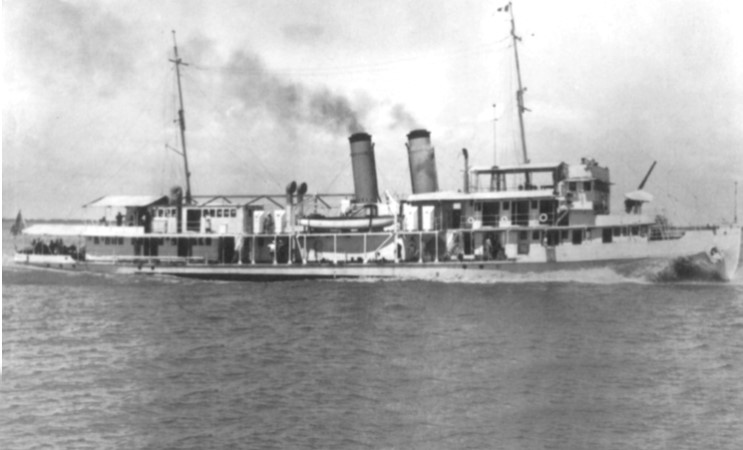 |
| USS Panay PR-5. |