
|
 |
 |
 |
 |
 |
 |
 |
 |
 |
 |
|
Tragedy for the Royal Navy seems to have been a way of life in the two world wars. Many are the instances of ships lost with only a few if any survivors. In 1941 one such example happened in the freezing waters of the Mediterranean. Ships from Force K including the cruisers HMS Neptune, HMS Aurora and HMS Penelope with the destroyers HMS Kandahar, HMS Lance, HMS Lively and HMS Havock, sailed from Malta to intercept an Axis convoy bound for Tripoli and Benghazi. The force made for the convoy at all possible speed through the waters of the Mediterranean. At about 01:00 on December 19, 1941, twenty miles from Tripoli, the single line of ships lead by the cruiser Neptune ran head first into a minefield. The filed had been laid by the Italians in April or June of 1941 and was unknown to the British. Neptune hit the first mine followed a minute later by an explosion on Aurora. Captain O'Connor of the Neptune ordered the ship to full reverse, but in doing so hit a second mine, which destroyed her screws and steering. Moments later a third mine detonated amidships abaft of the funnel. This put her fires out and Neptune was dead in the water. With Aurora badly damaged and Neptune in sinking condition the other ships stood by to either tow the ships or rescue survivors. However at 01:10 HMS Penelope hit a mine and this halted any rescue operations for the moment. There was considerable confusion as to what to do aboard the ships that were so far undamaged. One concern was that they were only twenty miles from enemy air bases that could easily strike them. Nobody wanted to be in the area at daybreak. Aurora which had been seriously damaged, retired with the destroyers Lance and Havock as escorts leaving Penelope, Lively and Kandahar to look after Neptune. The captain of the Penelope ordered Lively to move in closer to Neptune and to advise him as to what he could do. The Kandahar began to move toward Neptune, but was ordered to halt until Lively could report. About two hours had passed when Penelope began to move toward Neptune, suddenly there was an explosion on Kandahar. Two miles from Neptune she had struck a mine which blew her stern off, now two ships and crews were in serious peril. All operations ceased, Penelope and Lively could do nothing, almost an hour passed before the final explosion. At 04:00 Neptune triggered a fourth mine, rolled over and sank. The only account of what happened on Neptune comes from the only survivor, Able Seaman John Norman Walton, he said; "Then we hit a fourth mine and we were lifted up and dropped back again. I got the Petty Officer off the forecastle from beneath the anchor chain but he had broken his back. Four of us - Price, Middleton, Quinn and me climbed down the anchor. They jumped in, but I wanted somewhere to swim to, not just float around, and when I saw a Carley raft I jumped in and swam to it.... I took the tow rope back to Middleton, who had no lifejacket, and when we got back to the raft it was crowded - about 30 people on and around it. We saw the ship capsize and sink, and gave her a cheer as she went down. We picked up Captain O'Conor, who was clinging to what looked like an anchor buoy, and he and three other officers finished up on a cork raft attached to ours. The sea was thick with oil and most of us had swallowed a lot of it. A few died around us that night and at daylight there were 16 of us left. The weather was pretty rough, and two officers tried to swim towards the Kandahar, but they never made it." Captain A. D. Nicholl of the Penelope had to make an agonizing decision. It is moments like these that haunt a man forever, the life and death decisions that commanders face no one can envy. In this case Nicholl had one ship lost and surely he thought hundreds of men in the water and another ship dead in the water with hundreds of more lives on the line. His ship, Penelope and the Lively both within enemy range with dawn approaching. With two badly needed ships and the lives of hundreds of men in his hands this was a decision that no man should have to make, but the necessities of war cause such painful moments. Perhaps the signal from captain Robson of Kandahar eased his mind. Robson signaled "Suggest you should go. Consider sending submarine to pick up survivors". And so the decision was made to withdraw. The captain of the Lively, W. F. E. Hussey, could not stand the thought of leaving the scene and signaled to Nicholl "Suggest I go for Neptune's survivors" but, Nicholl signaled back "Regret not approved". Penelope and Lively departed for Malta, but Nicholl broke radio silence to request a submarine or flying boat be sent to the scene. Kandahar was never found by the enemy and her crew were rescued by HMS Jaguar in the early morning hours of Dec. 20. However the sea was so rough that they had to swim from the Kandahar to the Jaguar. Before the Jaguar left the scene with one hundred and seventy four survivors, Kandahar was scuttled. No survivors from Neptune were found by the British, but Walton and fifteen others were drifting in the cold water. By Dec. 24 there were only two men still alive on the raft, Walton and Price. During the day an aircraft was seen and Walton waved to it. An hour later he was a PoW when an Italian torpedo boat picked him and Price up. After climbing aboard the boat Walton collapsed, he woke up on Christmas Day in a hospital in Tripoli and was told that Price had died. This made him the only survivor out of a crew of seven hundred and sixty-five. Along with the British crewmen on Neptune there were one hundred-fifty New Zealanders, seventeen South Africans and two Australians all of whom perished. The loss of the New Zealanders made it the single largest loss of life that the New Zealand navy would incur in World War 2. John Norman Walton, remained a PoW until 1943 when he was released by the Italians, he returned to the Royal Navy and served on a frigate escorting convoys to Russia and then on a the minesweeper HMS Rowena. He returned to duty and served for five years in Korea. Sadly Mr. Walton died at age 84 on April 20, 2005. |
© 2005 Michael W. Pocock MaritimeQuest.com |
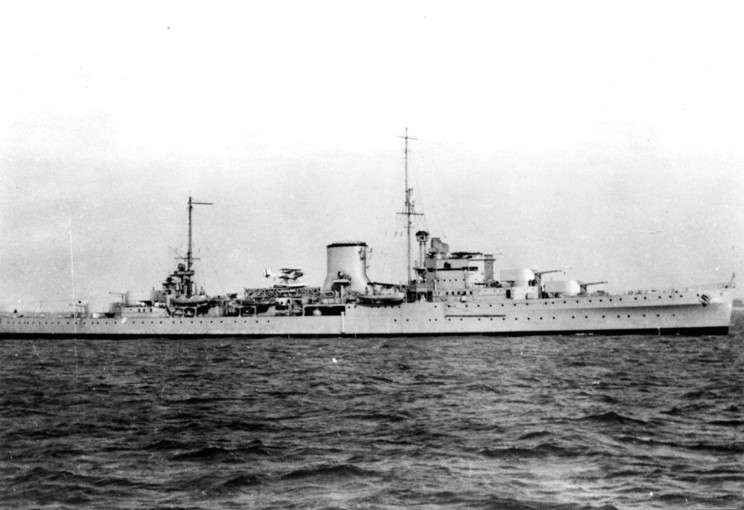 |
HMS Neptune, date and location unknown. |
 |
 |
 |
 |